
Five easy STEAM experiments to try at home with preschoolers
Simple science, technology, engineering, arts and maths activities using things you already have in the kitchen.
Key takeaways
- STEAM is about curiosity, asking questions and testing ideas.
- Everyday materials such as cups, food colouring and bicarb soda are perfect.
- Ask "What do you think will happen?" before you start.
STEAM stands for Science, Technology, Engineering, Arts and Mathematics. For young children, it simply means being curious, asking questions and having a go. Here are five easy activities to try at home. Always supervise closely.
1. Fizzing volcano
Put a few spoonfuls of bicarb soda in a cup on a tray. Add a drop of food colouring. Let your child pour in a little vinegar and watch it fizz. Ask: What happened? What if we add more vinegar?
2. Sink or float
Fill a tub with water and collect objects: a cork, a spoon, a leaf, a toy car, an apple. Ask your child to guess before testing each one. Sort them into two groups.
3. Rainbow walking water
Line up three cups. Fill the outer two with water and different food colours. Fold paper towel strips to bridge between the cups. Over a few hours, the colours travel and mix in the middle cup.
4. Build the tallest tower
Using blocks, cups or recycled boxes, challenge your child to build the tallest tower that stands on its own. Measure it with a tape measure or count the blocks. What made it fall? How could it be stronger?
5. Shadow drawing
On a sunny morning, place toy animals on paper outside and trace their shadows. Come back in the afternoon. Has the shadow moved? Why?
Tips for talking science
- Ask open questions: "What do you notice?" "Why do you think that happened?"
- Use real words like predict, observe and experiment.
- Let your child lead, and do not worry about the right answer.
STEAM at our centre
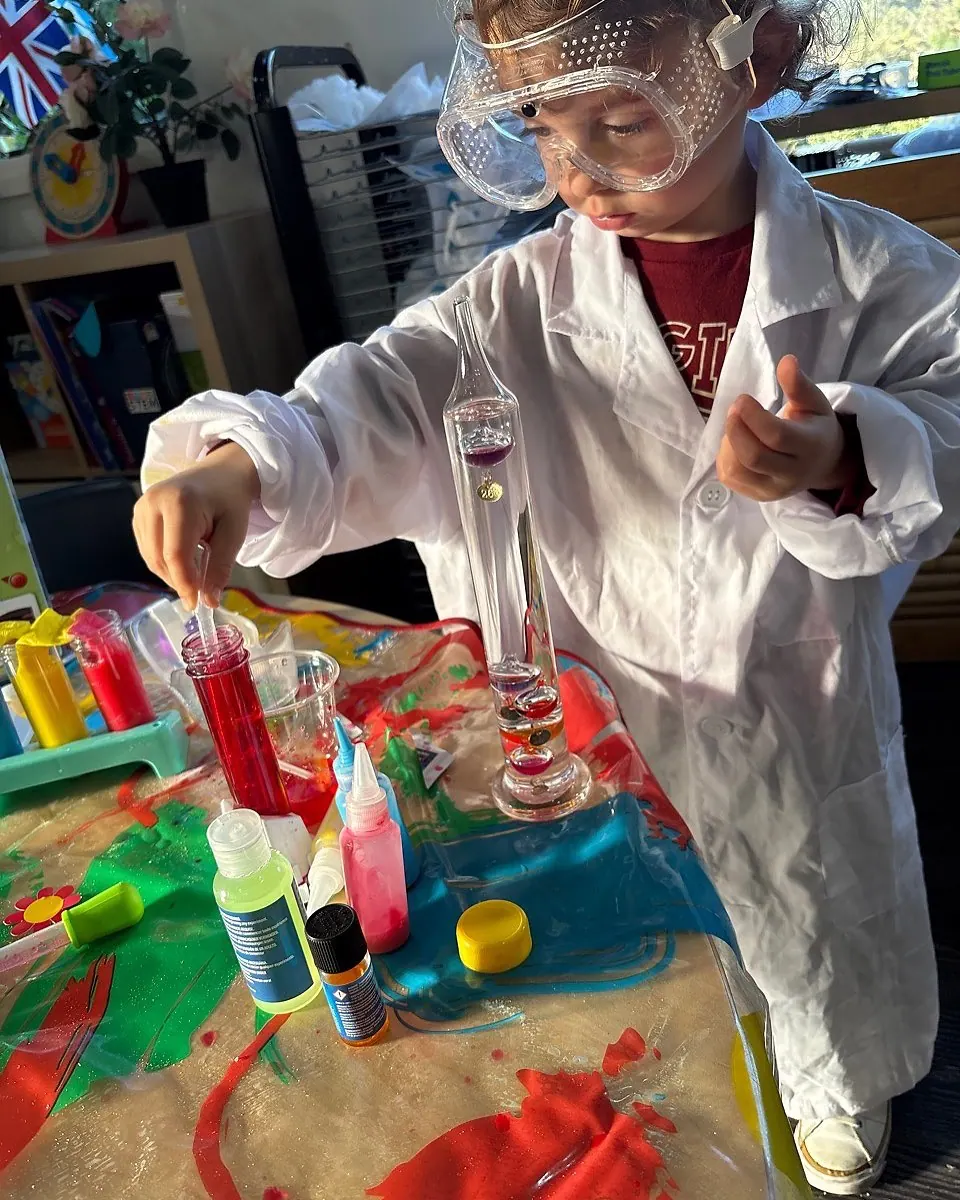
Our STEAM education program offers hands on experiments, building and early technology, including robotics, throughout the year. Children love dressing up as scientists for experiments and exploring space, insects and life cycles.
Questions parents ask
What is STEAM in early childhood?
STEAM stands for Science, Technology, Engineering, Arts and Mathematics. In the early years it means hands on play that encourages curiosity, prediction, problem solving and creativity.
See it for yourself
Visit our West Pymble centre and meet the team.